
Veneto was the starting point of our summer road trip through northern Italy. We chose this region because it brought together so many things we love. Local food and wine, historic towns and villages, beautiful countryside and easy access to the mountains. After exploring the Prosecco Hills, we continued into the Dolomites, a trip that combined culture, history, culinary traditions and nature.

We were particularly curious about how Veneto’s food culture is shaped by its diverse landscape. We fell in love with Piedmont’s slow food scene already and noticed some similarities in the food scenery here. Stanley Tucci’s food documentary, which features Veneto in one of its episodes, inspired our decision to explore the region.
During our journey, we discovered some of Veneto’s flavours. Wines, local drinks and sweet specialities, including Prosecco, grappa, tiramisù and Mezzo e Mezzo. Staying at Agriturismo Althea, a family-run winery and farmhouse in the Conegliano Valdobbiadene hills, gave us the perfect base to explore the region’s food culture.
You are a Slow Food Maniac like us? Then you shouldn’t miss our other slow food guides around the world, from the juicy Fiorentina Steak in Tuscany to Southwestern USA style BBQ grill. Here are all our culinary travel stories.
In this guide, we explore Veneto’s food traditions and the places where you can experience its culinary heritage.
Veneto’s Food Culture: Where Landscape & History Meet
Veneto is a region of remarkable contrasts. It stretches from the Adriatic coast and Venetian Lagoon through fertile plains and rolling hills to the dramatic peaks of the Dolomites. This variety is not only beautiful to explore, but also plays an important role in the region’s food culture. Rivers flowing down from the Alps, agricultural land, coastal lagoons and different elevations have all influenced the ingredients people grow and the food traditions that have developed over centuries.
The Venetian plain is more diverse than it might first appear. The higher plain is largely made up of gravel and sediments carried down from the mountains by rivers. The lower plain has more groundwater and natural springs, creating favourable conditions for farming. Water has always been important to agriculture here, supporting the cultivation of crops such as rice, vegetables and maize. As you travel from the plains towards the mountains, the landscape changes — and so do the local food traditions.
Veneto’s history has also had a strong influence on its cuisine. The Republic of Venice was once a major maritime trading power, connecting the Mediterranean with the Middle East and Europe. These connections brought new ingredients and cooking influences from distant places. Spices, raisins and vinegar, for example, became important in dishes such as sarde in saor. Rice and dried cod also reflect the region’s long trading history. The arrival of maize from the Americas later changed rural food culture, helping polenta become one of Veneto’s specialties.
🍴 Explore More Italian Food Culture: We love discovering a destination through its food — from traditional recipes and local ingredients to the landscapes and history behind them. If you enjoy travelling this way, take a look at our other Slow Food journeys through Italy, including Piedmont and Sicily.
Traditional Dishes of Veneto: From Regional Mountain Dishes to Tiramisù
When you look at a menu in Veneto you realize quickly that food here changes completely depending on where you are. One day you’re up in the mountains and the next you’re down in the plains or near the water. That’s what makes eating your way through the region so much fun.
Here are some of our favorite Veneto specialties, the stories behind them and a few personal highlights from our journey:
1. Casunziei
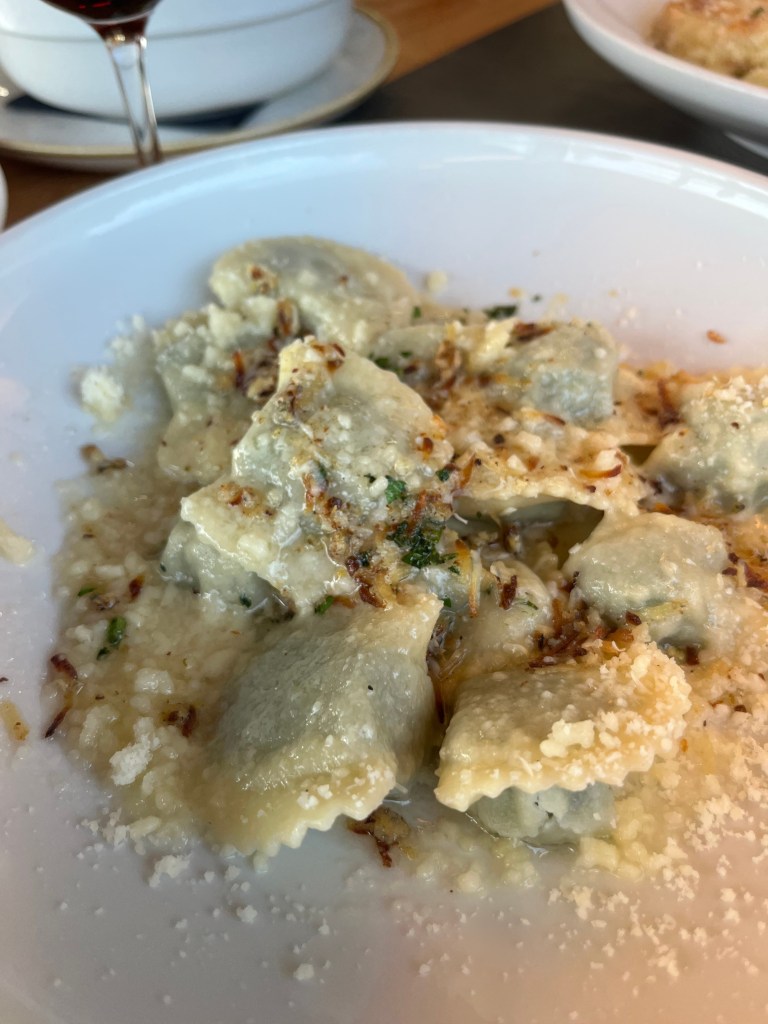
If you travel through the Dolomites, casunziei is a speciality worth trying. These half-moon-shaped pasta parcels are traditionally filled with beetroot, ricotta or spinach and served with melted butter and poppy seeds.
We tried casunziei in the Venetian part of the Dolomites after leaving the Prosecco Hills. I had already tried Schlutzkrapfen, a traditional stuffed pasta from the Alpine region and noticed the similarity. However, the filling and flavours were quite different.
Our casunziei had spinach or ricotta filling. Combined with the melted mountain butter and poppy seeds, the result was delicate, comforting and full of flavour. It was a lovely introduction to the mountain cuisine of Veneto.
Like many traditional mountain dishes, casunziei developed around ingredients that were available locally and seasonally. The fillings vary between valleys and families, making each version a little different.
2. Tiramisù
Tiramisù is, without a doubt, my favourite dessert. So, visiting Treviso, the city widely associated with its origins, was a dream come true for me.

I have enjoyed tiramisù in many different places, but trying it in Treviso felt particularly special. It certainly lived up to my expectations. The tiramisù we tried was incredibly creamy and intense in flavour, with a beautiful balance of coffee, mascarpone and cocoa.
Tiramisù is traditionally made with mascarpone, espresso-soaked ladyfingers (savoiardi) and cocoa powder. Its name comes from the Italian expression tirami su, meaning “pick me up”.
Treviso is closely connected to the modern history of tiramisù, particularly through the restaurant Le Beccherie. However, the dessert’s exact origins remain a subject of debate.

3. Bigoli in Salsa
Before you even hit the fancy restaurants in Venice or Treviso, look out for bigoli. It’s a thick whole-wheat pasta that has a wonderfully chewy texture designed to hold onto heavy sauces. It reminded us on pici pasta we fell in love with during our Tuscany slow food trips. The Veneto preparation is in salsa—a simple, slow-cooked sauce made of sweet onions and salted anchovies.
Historically, bigoli in salsa was a “lean day” dish, eaten on Fridays or before religious holidays when meat was forbidden. Don’t let the anchovies scare you; slow-cooking breaks them down into a deep, savory umami flavor rather than anything fishy.

4. Sarde in Saor
This dish is a brilliant example of Venice’s ancient trading past. Sarde in saor is made of fried sardines, marinated in a sweet-and-sour caramelized onions, vinegar, raisins and pine nuts.
It sounds like an unusual combination, but the contrast between the rich fish, sharp vinegar and sweet raisins is incredible. In the Venetian Republic, sailors invented this method because the vinegar and onions preserved the fish for long journeys at sea.
5. Risotto & Risi e Bisi
While much of Italy loves dried pasta, Veneto are all about rice. Specifically historic varieties like Vialone Nano grown right in the region.
Risi e Bisi sits somewhere between a soup and a risotto, made with green peas, pancetta and a rich broth. Historically, it was served to the Doges of Venice every year on the feast day of Saint Mark.

6. Radicchio di Treviso
If you travel through Veneto in the colder months, you will see fields of striking, deep-red leafy chicory everywhere. Radicchio Rosso di Treviso is protected with a PGI status and for good reason. It’s crisp, slightly bitter, and completely transforms when cooked.
Locals grill it on open flames with some olive oil, toss it into warm risottos or bake it. The slight bitterness cuts through rich cheeses and meats, making it an essential balance to many traditional Veneto meals.

Prosecco in Veneto: Exploring the Wine and Its Landscape
During our Veneto trip, we decided to stay in the Prosecco region. We wanted to experience not only the wine itself, but also the beautiful landscape surrounding its vineyards.
We found the ideal base at Agriturismo Althea, a Prosecco agriturismo in the eastern part of the wine region. It was just around 10 minutes from San Pietro di Feletto and Conegliano, our starting points for the famous Strada del Prosecco.

⚽️ Real over Perfect: Prosecco, sunset… and football! Not every Italian evening has to look like a travel magazine. During our stay at Althea, we bought our own bottles of Prosecco, labelled them in the fridge and took them out to the terrace each evening. We had the beautiful Prosecco Hills around us — and our iPad showing the 2026 FIFA World Cup. Honestly, it was perfect. Good wine, a beautiful view, football and time together. Sometimes the most memorable travel moments are the completely ordinary ones.
Prosecco Hills Geology and History
The Prosecco Hills are located in the province of Treviso, between the foothills of the Alps and the Venetian plain. Its position between creates a relatively mild climate, with breezes that help the grapes dry after rainfall. The hills also provide different sun exposures, contributing to the conditions in which the Glera grape—the main grape variety used for Prosecco—is grown.

One of the most fascinating features of the landscape is its traditional vineyard terraces, known as ciglioni. These narrow, grassy terraces follow the contours of the steep hillsides and help stabilise the soil. Many vineyards require manual work because of the terrain, making winemaking here very different from working on flat land.
💡 Did you know? The landscape around Conegliano and Valdobbiadene was recognised as a UNESCO World Heritage Site in 2019. What makes it particularly interesting is that the designation recognises the relationship between people and the landscape — including the centuries of vineyard cultivation on these steep hillsides.
The famous Strada del Prosecco also has a long history. Established in 1966, it is recognised as Italy’s first wine road. Today, driving through the Prosecco Hills offers a wonderful way to discover the small villages and the rural landscape that gives the wine its identity.
For us, this is what made exploring the Prosecco region so enjoyable. The wine was only one part of the experience. The landscape and the work involved in cultivating all added meaning to every glass we enjoyed during our stay.
A Long History of Prosecco Winemaking
Although wine has been produced in the area for centuries, the development of modern Prosecco production was particularly influenced by the educational traditions of Conegliano. The School of Oenology in Conegliano was established in 1876 and played an important role in the development of local winemaking knowledge.
Another interesting detail is the bellussera vine-training system, which was developed in the late nineteenth century by the Bellussi brothers. The method arranged vines around tall supporting posts, creating a distinctive geometric pattern. You can still find examples of this traditional system in the region.
Prosecco Classifications & The Difference Between DOC and DOCG Prosecco
When you start looking at wine labels in Veneto, you quickly notice that not all Prosecco is equal. I always wondered why some bottles cost just a few euros while others are more expensive. Exploring the hills and talking with local producers made it much clearer.
It all comes down to where the grapes are grown and how strict the production rules are. Here is a simple way to break down the main classifications:
- Prosecco DOC: This is the broader designation, covering a massive area across nine provinces in Veneto and Friuli-Venezia Giulia. Because the plains here are much flatter, people harvest the grapes mechanically on a large scale. These wines are fresh, fruity and easy-drinking—perfect for everyday casual sipping or mixing into an Aperol Spritz.
- Prosecco DOCG: The “G” stands for Garantita, meaning stricter quality controls. This is the top tier wine. It’s produced in the historic, hilly heartland between Conegliano and Valdobbiadene. Because these hills are so steep, almost all the harvesting and vineyard work has to be done entirely by hand.
- Cartizze (Super Di Valdobbiadene): If you want to get really specialized, look for Superiore di Cartizze. It’s a tiny sub-zone of just 107 hectares of steep hillsides in Valdobbiadene, considered the grand cru of Prosecco. It yields a richer, more complex and slightly more aromatic sparkling wine.
Other Traditional Drinks of Veneto
Prosecco was of course our main local drink during our trip. But visiting Veneto and not exploring its other liquid specialties would be a total no-go. The region has a fascinating drinking culture rooted in local agriculture and craftsmanship.
1. Grappa
You cannot talk about Veneto’s wine culture without mentioning grappa. It is a traditional brandy made by distilling the left overs of winemaking —including the skins, pulp, seeds and stems.
Because Veneto produces massive amounts of wine, distilling the leftover grape pomace became a brilliant way to ensure zero waste. Instead of throwing away the skins, local producers turned them into a potent spirit.
Traditionally, locals drink grappa as a ammazzacaffè (coffee-killer) after a heavy meal to aid digestion. While I’m not usually a big grappa fan and my husband had to skip it during our early daytime stop in Bassano, its history and craftsmanship was fascinating.

2. Mezzo e Mezzo
When we were in Bassano del Grappa, we of course had to try something special. Since grappa was off the table for an early afternoon drink, we wanted to try a local specialty we had never heard of before: the Mezzo e Mezzo.
Having spent time in Barcelona early that year and fallen in love with the local vermouth culture there, the Mezzo e Mezzo immediately became one of my absolute favorite discoveries of our summer holidays. It is refreshing, not nearly as heavy as grappa and wonderfully intense in flavor.
🍸 A Nod to Barcelona’s Vermouth Tradition. The bitter-meets-sweet Mezzo e Mezzo will feel instantly familiar to anyone who loves Spain’s aperitif culture. To explore another fantastic city centered around historic daytime drinks and local bites, take a look at our Barcelona Slow Food & Vermouth Guide.
The name literally translates to “Half and Half”. It is a refreshing aperitivo made from equal parts of two proprietary Nardini liqueurs: Nardini Rosso (a bittersweet, herb-and-spice-infused red liqueur/vermouth style) and Nardini Rabarbaro (a deep, earthy bitter liqueur flavored with Chinese rhubarb). Traditionally, they serve it chilled over ice with some soda water and a slice of lemon or orange.

The drink was spontaneously invented in the 1970s at the historic Grapperia Nardini—Italy’s oldest grappa distillery, located right on the wooden Ponte Vecchio in Bassano del Grappa. The combination caught on so rapidly that it became the defining taste of the town. It eventually became so popular that Nardini officially began bottling a pre-mixed version.


Our Favorite Foodspots in Veneto
When you travel slowly, the places you choose to eat become a core part of the journey itself. These places are about the people, the atmosphere and the memories you make around the table. Here are three of our absolute favorite food spots from our time in Veneto:
1. Le Beccherie (Treviso)
If you want to experience tiramisù where history was officially made, this is the place. Located in the heart of Treviso, Le Beccherie is widely recognized as the birthplace of the modern dessert.
Beyond the fact that the tiramisù itself was perfection, what really stood out was the overall experience. The service was exceptionally professional, and sitting in the historic dining room where the recipe was first served made it feel like a pilgrimage for a dessert lover.
2. Al Larin Da Bepo (Near Conegliano)
Located conveniently close to our agriturismo in the eastern hills, this became our very first dinner stop of the trip.

While it might not have been the most strictly traditional historic osteria, the food was remarkably delicious. In fact, we loved the barbecue meat here. It was the ideal, welcoming spot to kick off our culinary adventures after arriving in the Prosecco Hills.


3. Osteria La Muda di San Boldo (Passo di San Boldo)
Dating back to 1470 and located in a dramatic mountain pass, Osteria La Muda is the oldest osteria in Veneto. Historically, a “muda” was a toll station and a resting place for travelers, merchants and pack animals crossing the mountain paths between the plains and the Belluno Dolomites. Back then, it was where people would pause and find shelter from the harsh elements.


This place was the ultimate slow food experience for us. With no Wi-Fi and even our GPS failing, we were disconnected from the modern world. Sitting by candlelight made it feel like a genuine hidden discovery rather than a tourist spot.
With no internet for translations, our wonderfully patient waitress walked us through the entire Italian menu. We tried hyper-local specialties we wouldn’t normally order, like herb-infused regional lasagne and local vegetables baked under regional mountain cheese. Best of all, sharing that screen-free, distraction-free evening with our teenager made it a truly unforgettable family memory.


