
One of our absolute favourite parts of travelling through Italy is eating and drinking. That’s one of the reasons Italy is our go-to slow food country. However, when we started travelling to Italy, we quickly realised that eating like a local can be surprisingly confusing. I still remember our early trips — sitting down for dinner while the dining room was completely empty, accidentally ordering a cappuccino at the wrong time of day or staring at a menu full of terms we didn’t recognise.
After years of travelling through different parts of Italy, we have learned a lot through trial and error. Italian dining isn’t really about following a stressful set of rules. It’s about understanding when to eat, what to order, where to find local ingredients and why certain dishes belong to certain places. You don’t need to worry about “eating perfectly Italian” — the goal is to eat locally.

Here is everything we wish someone had told us before our first trip, so you can skip some of the confusion, slow down and enjoy Italy the way it is meant to be tasted.
🍇 LOVE SLOW FOOD? We travel through Italy with food as part of the journey — from Piedmont’s truffles and wine to Sicily’s Mediterranean flavours and Veneto’s Prosecco hills. Explore our Italy Slow Food Guides →
Italy Is Not Just Pizza and Pasta
When international travellers think about Italian food, two dishes almost always come to mind: pizza and pasta. While both are famous across the country, they are only a small part of what Italian food culture is about.
Italy’s cuisine is deeply rooted in geography, climate and history — meaning what ends up on your plate can change dramatically depending on whether you are dining in the mountains, on the plains or by the Mediterranean coast.
This is also one of the reasons we love travelling through different Italian regions. We would much rather eat a dish we have never heard of because it belongs to a particular valley or town than order the same familiar pasta dish we could find anywhere in Italy.
🇮🇹 DID YOU KNOW? Italy didn’t become one country until 1861. For centuries, its regions developed their own languages, traditions and food cultures. That is why travelling from Sicily to Piedmont — or Veneto to Tuscany — can feel almost like travelling between different culinary worlds.
If you look at a huge menu that tries to offer everything at once — pizza, risotto, pasta from five different regions and dishes you normally associate with completely different parts of Italy — it can be a warning sign. It doesn’t automatically mean the restaurant is bad, but we usually feel more confident when the menu is shorter and clearly connected to the region we are visiting.
A small, focused menu that changes with the season often tells you much more about the kitchen and its connection to the local area.
Beyond the Wheat: Meat, Fish and Vegetables
Italian cooking relies heavily on seasonal, high-quality ingredients.
In regions such as Sicily, Liguria or Veneto, you may find seafood, salt cod and shellfish combined with ingredients such as citrus, capers and olive oil.

As you move inland towards the Alps or the Apennines — such as in the Dolomites or Piedmont — the cuisine becomes more influenced by hearty meats, local cheeses, butter, polenta and root vegetables.

Across regions such as Tuscany and Emilia-Romagna, vegetables, beans and legumes are important parts of traditional cucina povera, where simple ingredients were turned into filling and delicious dishes.

Why You Won’t Find Pizza Everywhere
Italy as a unified nation is relatively young, but its regional identities go back centuries. This history helped create food traditions that can be surprisingly different from one another.
While Neapolitan-style pizza is a global icon today, it was historically associated with Naples and Campania and only gradually became widespread across northern Italy.

So don’t travel through Italy expecting every restaurant to offer the same pizza-and-pasta combination. The more you move around, the more interesting the food becomes.
Pasta Isn’t Always Dinner
When people think about an Italian dinner, they often imagine a big plate of pasta topped with sauce and served as the main event. In Italy, pasta can play a slightly different role in a traditional meal — and understanding this can completely change how you order.
The Traditional Meal Structure — And Why You Don’t Need Five Courses
Traditionally, a formal or complete Italian meal follows a classic order:
- Antipasto: The starter, such as cured meats, cheeses or seasonal vegetables.
- Primo: The first course, usually a carbohydrate-based dish such as pasta, risotto or soup.
- Secondo: The main course of meat, fish or poultry.
- Contorno: A vegetable or salad side dish, normally ordered separately.
- Dolce: Dessert, often followed by coffee and perhaps a digestivo.
🇮🇹 How an Italian Meal Works
You don’t have to order every course. Think of these as the traditional building blocks of an Italian meal.
You don’t need five courses. A simple primo for lunch, a secondo with contorno for dinner, or just dessert and coffee are all perfectly normal.
Locals mix and match depending on their appetite, the occasion and the time of day. You might have an antipasto and primo, just a pasta dish for lunch or a secondo with a contorno for dinner.
Pasta at Lunch vs Dinner
Pasta is very common as a satisfying midday meal (primo), often enjoyed at a local trattoria or osteria as part of the daily routine.
And for dinner? Pasta still frequently appears as a primo. The important thing is that it doesn’t have to be a huge bowl of pasta with everything else piled on top. Traditional Italian cooking usually treats the different courses separately.

Of course, you can absolutely order just a plate of pasta — especially at lunchtime or in a casual restaurant. There is no need to turn every meal into a five-course event.
Where Pasta Belongs to the Region
Because Italian cuisine is intensely regional, the type of pasta you eat can tell you a lot about where you are. Different areas have their own shapes, doughs, fillings and sauces, often connected to local agriculture and traditions.
If you want to dive deeper into these regional traditions, you can explore how pasta varies across some of our favourite corners of Italy:
- Liguria: Home to hand-twisted trofie pasta with aromatic basil pesto made with local olive oil and pine nuts. And one of our favourite food memories here wasn’t in a fancy restaurant at all — we had pesto made in a tiny village kitchen, just like a local grandmother might make it. Check it our in our Cinque Terre Travel Guide.

- Emilia-Romagna: The home of egg pasta, including tagliatelle al ragù, traditionally made with broad ribbons of pasta rather than spaghetti. You can find some signature dishes in our Bologna City Guide.

- Veneto: Think of rich, savoury dishes such as bigoli in salsa, made with thick pasta and an anchovy-and-onion sauce. You can read more about it in our Veneto Slow Food Guide.

- Tuscany: Famous for hand-rolled, thick pici, often served with garlic, tomato or wild ragù. We also discovered how good simple Tuscan food can be during our Tuscany Slow Food Guide.

- Piedmont: Home to delicate pasta such as tajarin and agnolotti, as well as some of northern Italy’s most famous food and wine traditions. Read more in our Piedmont Slow Food Guide.

- The Dolomites: Mountain dishes include folded pasta such as casunziei, which we tried during our time in the Venetian Dolomites, as well as Schlutzkrapfen in neighbouring alpine regions.
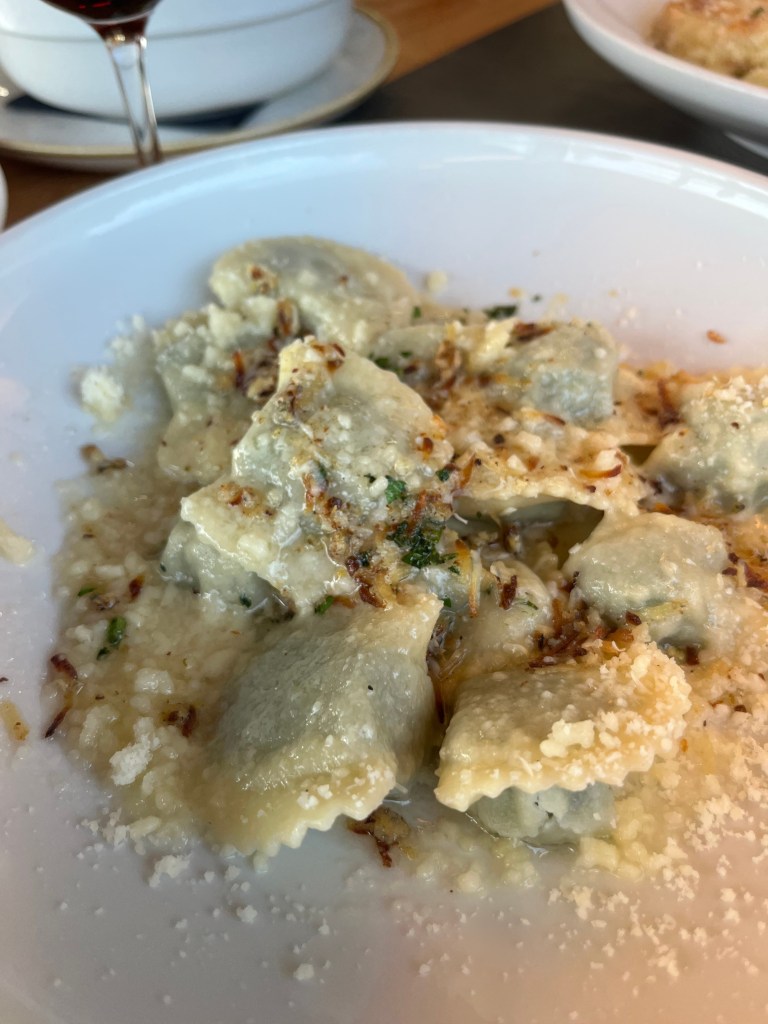
- Sicily: Where pasta meets the Mediterranean, with dishes such as Pasta alla Norma made with aubergine, tomato and salted ricotta — one of my husband’s favourites. Find more in our Sicily Slow Food Guide.

Italian Meal Times: When Do Italians Actually Eat?
One of the biggest culture shocks for us when we first travelled to Italy wasn’t the food itself — it was the clock. If you have ever tried to sit down for dinner at 6pm only to find a completely empty dining room, you know what I mean.
The truth is, there isn’t one universal Italian eating schedule. Mealtimes change depending on the region, the setting, the season and the daily rhythm of life. But there are some general patterns worth knowing.
Italian Breakfast: Keep It Light and Sweet
The traditional Italian breakfast is usually much lighter and sweeter than the breakfast many travellers are used to in Northern Europe or North America.
Italian Breakfast (la colazione) is often a coffee and something sweet, such as a cornetto, eaten quickly at a local bar before work or school.

A cornetto is similar to a croissant, although the dough and fillings can be different depending on where you are. You might find apricot jam, custard, chocolate or other regional pastries.
In Sicily, breakfast can be a completely different experience again, with local pastries and, in summer, even granita with brioche.

It’s a fast, social morning ritual where people pop into a café, exchange a few words with the barista and continue with their day.
We actually love this ritual. A quick espresso and something sweet at a local bar feels like a much more Italian start to the day than sitting in a hotel breakfast room for an hour.
Lunch: Midday Recharging
Traditionally, Italian lunch (il pranzo) was the most substantial meal of the day, although modern working life has changed this for many people.
A typical lunch window is around 12.30pm to 2pm, although it varies considerably.
This is a common time to enjoy a primo, such as pasta or risotto, or a daily special (menu del giorno). In many local trattorias, lunchtime is when you will see working people, families and tradespeople sitting down for a proper meal.
Regional differences play a huge role here. A coastal lunch in Sicily can look completely different from a hearty lunch in a mountain village in the Dolomites.
Aperitivo: The Pre-Dinner Ritual
Sitting somewhere between late afternoon and dinner, aperitivo is less about having a full meal and more about winding down, socialising and enjoying a drink before dinner.
Usually between around 6pm and 8pm, you might order a glass of wine, a Spritz, a local bitter or another regional drink alongside olives, nuts, crisps or small snacks.

But aperitivo also changes from region to region. In Veneto, for example, the tradition of cicchetti gives you the chance to try several small local bites with your drink.
🍷 Want to experience aperitivo in Veneto? Read about our Mezzo e Mezzo experience in Bassano del Grappa in our Veneto Slow Food Guide.
Dinner: Later Than You Think
If you arrive at a restaurant right when it opens at 7pm, you may be the only people there — and the staff might still be getting ready.
For many Italians, 8pm to 9pm is a much more typical dinner window, although this varies considerably by region and type of restaurant.
Italian dinner can start even later in southern Italy and in cities such as Rome or Palermo, particularly during the summer. In smaller northern mountain towns or quiet family-run places, things may happen a little earlier.
🕰️ SLOW TRAVEL TIP. If dinner starts later than you’re used to, don’t spend the evening waiting for the restaurant to open. Have an aperitivo. Walk through the town. Sit in a piazza. Order a glass of local wine. The slower rhythm is part of the experience.
Coffee: The Rules Tourists Keep Getting Wrong
If you ask us, a proper morning in Italy simply cannot begin without coffee. It is one of our absolute favourite daily rituals whenever we travel through the country.
In Italy, coffee is about much more than caffeine or taste — it is part of the daily rhythm. We love stepping into a neighbourhood bar, ordering a quick espresso, exchanging a few friendly words with the barista, paying our small change and heading back out into the streets.
To help you navigate this ritual without worrying about accidentally committing a tourist faux pas, let’s clear up some of the myths.
The Cappuccino After 11am Rule — And Why Nobody Will Arrest You
Let’s address the internet’s favourite Italian food rule first: Can you really not drink a cappuccino after 11am?
First of all, relax. Italians aren’t going to throw you out of the café if you order one in the afternoon.
However, milk-based coffee is traditionally associated with breakfast in Italy, and ordering a large cappuccino after a heavy lunch or dinner simply isn’t part of the usual Italian routine.

So yes, you can order one. But if you want to blend in, stick to cappuccino in the morning and espresso after a meal.
Standing at the Bar vs Sitting at a Table
Another detail that catches travellers off guard is the difference between drinking your coffee al banco and al tavolo.
- Al banco: At the counter. This is the quick coffee ritual many locals follow.
- Al tavolo: At a table. You are paying for the table service and the more relaxed experience, so the price can be considerably higher.
We actually enjoy both. If we’re rushing between sights, we’ll happily have an espresso standing at the bar. If we’re not in a hurry, sitting outside with a coffee and watching the world go by is part of the experience too.

Regional Coffee Specialities
Italy’s regional diversity even appears in its coffee.
In Turin, Piedmont, you can try a traditional Bicerin, made with espresso, hot chocolate and milk or cream, served in a small glass.
In Puglia, Caffè Leccese combines espresso, ice and sweet almond milk — perfect for a hot summer day.
And Sicily has its own coffee traditions and variations, reflecting the island’s long history of Mediterranean and Arab influences.
How to Order Coffee Like a Local
Here are a few useful expressions:
| If you want… | Say… |
| A standard espresso | Un caffè, per favore |
| An espresso with a little milk | Un caffè macchiato, per favore |
| A cappuccino | Un cappuccino, per favore |
| Coffee with plenty of milk | Un caffè latte, per favore |
| Another coffee | Un altro caffè, per favore |
| Coffee after lunch | Un caffè, per favore |
☕ Italian Coffee: What to Order & When
Italian coffee is simple, quick and deeply part of everyday life.
| When | Try | What to expect |
|---|---|---|
| 🌅 Breakfast | Cappuccino + cornetto | The classic Italian morning combination |
| ☕ Anytime | Caffè | A small, strong espresso |
| 🍽️ After lunch | Caffè | Usually a quick espresso |
| 🥛 Want some milk? | Caffè macchiato | Espresso with a small amount of milk |
| 🚶 Quick stop | Al banco | Drink your coffee standing at the counter |
| 🌿 Taking your time | Al tavolo | Sit down and enjoy it at the table |
Nobody will arrest you for ordering one after 11am. But traditionally, milk-heavy coffee is associated with breakfast rather than the end of a meal.
What Do All Those Italian Restaurant Names Actually Mean?
Walking down an Italian street, you will see signs for ristorante, trattoria, osteria, enoteca, agriturismo and more. They may all be places where you can eat, but the names can give you an idea of the style and atmosphere.
1. Ristorante
A ristorante is generally the more formal category, although there is plenty of variation.
You can expect full table service and often a broader menu and wine list. Some are very elegant, while others are surprisingly relaxed.
2. Trattoria
A trattoria is traditionally a more informal restaurant, often associated with family cooking and local dishes.
This is often where we start looking when we want traditional regional food rather than a formal dining experience.
Expect a relaxed atmosphere, regional recipes and sometimes a handwritten menu or daily specials.
3. Osteria
Historically, an osteria was more focused on wine and simple food. Today the word can mean many things, from a tiny neighbourhood wine bar to a modern restaurant.
Don’t assume that every osteria will be rustic — but if you find a small one with a short local menu, it is definitely worth investigating.
4. Agriturismo
An agriturismo is a farm-based hospitality concept, and the exact legal requirements vary by region.
You may stay overnight, eat meals prepared with ingredients from the farm or surrounding area, or simply visit for a meal or food experience.
For us, agriturismos are one of the best ways to combine slow travel and slow food because the landscape, the accommodation and the food are all connected.
This is exactly why we chose to stay at a Prosecco-producing agriturismo in Veneto.
5. Enoteca
An enoteca is essentially a wine-focused establishment.
You will often find a good selection of wines by the glass (al calice) alongside small plates, cured meats and cheeses. Some modern enotecas also offer a full regional menu.
6. Pizzeria
A pizzeria is focused primarily on pizza, although many also offer starters, salads, desserts and sometimes pasta.
And don’t expect every pizzeria to be open all day. Traditional pizza ovens often come alive for the evening service.
7. Bar & Bacaro
An Italian bar is much more than a place for alcohol. It can be your breakfast stop, coffee shop, quick lunch spot or aperitivo bar.
A bacaro, on the other hand, is particularly associated with Venice and the Veneto. These small local wine bars are where you can enjoy cicchetti — small bites — with an ombra, a small glass of wine.
🍷 Which Italian Eatery Should You Choose?
The name above the door can tell you quite a lot about the kind of experience to expect.
How To Read An Italian Menu
When you first sit down at an Italian restaurant, the menu can sometimes look like a foreign language — literally. But once you understand the basic structure and learn a few useful words, reading an Italian menu becomes part of the fun.
The Standard Italian Menu Layout
Most traditional menus follow the order of the meal:
- Antipasti: Starters such as cured meats, cheeses, vegetables or small regional specialities.
- Primi: Pasta, risotto, gnocchi and soups.
- Secondi: Meat, fish or poultry, usually served without a side dish.
- Contorni: Vegetables, potatoes or salads, normally ordered separately.
- Dolci: Desserts, sometimes followed by fruit or cheese.
Special Slow-Food Menu Terms
If you want to spot dishes that are connected to the local area or season, look out for these words:
- Stagionale — seasonal.
- Locale / del territorio — local or from the surrounding area.
- Fatto in casa — homemade.
- Artigianale — artisan-made.
- Menu del giorno — menu of the day.
- Piatto del giorno — dish of the day.
- Pescato del giorno — catch of the day, particularly useful near the coast.
And one of our favourite questions is simply: “Cosa ci consiglia?” — What do you recommend?
Sometimes the answer tells you much more about a restaurant than the menu does.
The Bread, Water & Coperto Situation
When the bill arrives in Italy, a few things can catch travellers by surprise. Understanding bread, water and coperto will save you from wondering what those extra charges mean.
Bread and Olive Oil: Our Favourite Ritual
In Italy, bread may arrive automatically at the table, but it isn’t necessarily free. Depending on the restaurant and region, it may be included in the coperto or charged separately.
Whenever bread lands on our table, it becomes one of our favourite little rituals.
Fresh, crusty bread with really good local olive oil is a small culinary highlight in itself. We often ask for some good olive oil to go with the bread, enjoying it with a glass of local wine while we look over the menu and settle into the evening.
Still or Sparkling Water
When you order water, the waiter will often ask:
“Naturale or frizzante?”
Acqua naturale is still water and acqua frizzante is sparkling water.
Bottled water is very common in Italian restaurants, although whether tap water is available varies from place to place.
The Coperto Explained
Look closely at your receipt and you may see a line called coperto.
This is a traditional cover charge associated with sitting at the table. It is not the same thing as a tip, and the amount varies by restaurant.
And don’t confuse coperto with a service charge or gratuity. They are different things.
Tipping in Italy is generally much less automatic than in countries such as the US. If you received particularly good service, leaving a few euros or rounding up the bill is a nice gesture, but there is no need to automatically add a specific percentage.
Italian Wine: You Don’t Need To Be A Wine Expert
Wine is an important part of Italian food culture, but it can easily feel intimidating if you start worrying about vintages, grape varieties and complicated terminology.
Our advice is simple: drink locally.
If you are sitting in a wine-producing region, don’t automatically order a bottle you already know from home. Ask what is local and what works with your meal.
House Wine vs The Regional Cellar
- Vino della casa: House wine. In a traditional trattoria or osteria, you may be able to order it by the glass (calice) or in a small carafe.
- Al calice: Wine by the glass.
- Bottiglia: A bottle.
- Mezzo litro: Half a litre.
If you’re unsure, simply ask:
“Quale vino ci consiglia?” — Which wine would you recommend?
Our Favourite Regional Wines
When you travel through Italy, every region has its own wine traditions.
- Veneto: From Prosecco in the hills to many other local wines, Veneto is one of Italy’s most fascinating wine regions. We particularly loved exploring the Prosecco Hills and staying at a family-run winery. Read more in our Veneto Slow Food Guide.
- Piedmont: Famous for wines such as Barolo, Barbaresco and Barbera, produced among the beautiful hills of the Langhe and Monferrato. Explore our Piedmont Slow Food Guide.

- Tuscany: From Chianti Classico to Brunello di Montalcino, wine is deeply connected to the landscape and food culture. We explored some of these traditions on our Val d’Orcia Road Trip.

- Sicily: The island’s volcanic landscapes and Mediterranean climate create a fascinating wine culture, from Etna wines to Nero d’Avola. Discover more in our Sicily Slow Food Guide.

Seasonal & Regional Food: Stop Looking For The “Italian Menu”
If there is one golden rule to take away from this entire guide, it is this:
There is no single, uniform “Italian cuisine”.
Veneto is not Tuscany. Piedmont is not Sicily. Just as the climate, dialects and architecture change as you travel across the peninsula, the food changes too.
Italian cooking is strongly connected to two things: where you are and what is in season.
When you stop looking for generic national dishes and start asking, “What is local and in season here?”, you aren’t just eating dinner — you are connecting with the landscape and the people who have shaped it.
A Taste of the Regions: Why You Should Eat What’s Native
When you embrace regional eating, every meal tells you something about the landscape you are standing in.
- Veneto: From the Venetian Lagoon and plains to the foothills of the Dolomites, expect dishes such as bigoli in salsa, risotto, radicchio and many local specialities. Explore our Veneto Slow Food Guide.

- Emilia-Romagna: Famous for egg pasta, ragù, Parmigiano-Reggiano and cured meats. You can explore the food culture in our 48-Hour Bologna City Guide.

- Liguria: Where mountains meet the sea, with pesto, trofie, savoury pies and seafood. We share some of our favourite experiences in our Cinque Terre Travel Guide.
- Tuscany: Rooted in cucina povera, with simple ingredients such as beans, pecorino, olive oil and pici. Explore more in our Tuscany Slow Food Guide.

- Piedmont: A paradise for lovers of rich, earthy flavours, with tajarin, agnolotti, truffles, hazelnuts and slow-cooked meats. See our Piedmont Slow Food Guide.

- Sicily: A fascinating mixture of Mediterranean ingredients, ancient trade routes and island agriculture, with citrus, capers, aubergines, pistachios and seafood. Read our Sicily Slow Food Guide.

Go To The Market: Where The Local Food Story Begins
If there is one ritual we rarely skip when travelling through Italy, it is finding the local food market.
Whether it is a historic piazza market or a small village market, walking around the stalls is one of the easiest ways to understand what people in the region actually eat.

For us, the market is also an essential shopping trip. We rarely leave Italy without putting a few things into our suitcase that we simply cannot find in Germany.
Our Favourite Market Rituals & Take-Home Products
Our standard market routine usually includes a few non-negotiables:
- The Spice Mix: We always buy dried herbs and spices — especially our favourite combination of crushed peperoncino, dried garlic and basil. Back home, mixing this with good olive oil makes a quick pasta dish that instantly takes us back to Italy.
- Pici: Since hand-rolled pici is difficult to find in Germany and happens to be our daughter’s favourite pasta, buying a few bags directly from local producers has become almost mandatory.
- Cheese & Local Produce: We love tasting local cheeses and talking to vendors who are clearly proud of what they produce.
- Olive Oil: Some of our favourite culinary souvenirs come directly from the agriturismos we stay at. We love buying estate-produced olive oil when we know exactly which landscape and olive trees it came from.

And this is exactly what slow food means to us: not simply finding something that tastes good, but understanding where it came from and taking a little piece of that place home with us.
The Italian Food Myths To Remember
When you combine social media, travel forums and decades of international restaurants adapting Italian food, you end up with some interesting food myths.
Some travellers arrive in Italy terrified of breaking rules that don’t really exist, while others confidently order things that are very different from traditional Italian food.
Let’s clear up a few of the most common ones.
Myth No. 1: You Can’t Put Cheese on Seafood
The reality: It is certainly not common with every seafood dish, and many traditional recipes don’t use cheese at all. But the idea that Italians have a universal “never cheese with fish” law is too simplistic. There are traditional dishes where dairy and seafood do appear together.
Myth No. 2: Fettuccine Alfredo Is a Typical Italian Dish
The reality: Alfredo does have an Italian origin — the dish was created in Rome by restaurateur Alfredo di Lelio. But the creamy, chicken-and-Alfredo combination familiar from many international restaurants isn’t a typical everyday Italian dish.
Myth No. 3: Spaghetti Bolognese Is a Traditional Bolognese Dish
The reality: In Bologna, ragù alla Bolognese is traditionally served with fresh egg pasta such as tagliatelle. Spaghetti with meat sauce is much more of an international interpretation than a classic Bolognese pairing.
Myth No. 4: You Should Never Change Anything About Your Food
The reality: Italians certainly have strong opinions about traditional dishes, but there isn’t a police force checking what you order. Our advice is simply to taste the dish first before changing it. You might discover that the combination you were tempted to “fix” was actually perfect as it was.
Myth No. 5: Italian Food Is Always Heavy And Tomato-Based
The reality: Not at all. Northern Italian cooking often relies on butter, broths, cheese, herbs and rice rather than tomato-heavy sauces. Mountain cuisines can be based around polenta, potatoes, dairy and hearty soups.
This is another reason we love travelling through Italy: the food changes with the landscape.
Myth No. 6: Chicken and Pineapple Belong on Pizza
The reality: You are unlikely to find a traditional Hawaiian pizza in Italy, and chicken is certainly not one of the country’s classic pizza toppings.
Will anyone arrest you for ordering it? Of course not. But if you are trying to explore Italian food culture, there are probably more interesting toppings to discover.
Myth No. 7: Italians Always Drink Alcohol With Every Meal
The reality: A glass of wine or beer can certainly be part of a meal, but water is just as normal. It is perfectly common to order acqua naturale or frizzante and leave the wine for dinner or aperitivo.
The Ultimate Italian Food Cheat Sheet: Phrases You’ll Actually Use
You don’t need to speak fluent Italian to eat well in Italy. But knowing a few useful words and phrases can make ordering food, talking to waiters and shopping at markets much easier.
Here are the ones we actually think are worth saving before your trip:
At the coffee bar
- “Un caffè, per favore.” — An espresso, please.
- “Un cappuccino, per favore.” — A cappuccino, please.
- “Un caffè macchiato.” — An espresso with a little milk.
- “Un caffè latte.” — Coffee with plenty of milk.
- “Al banco, per favore.” — At the counter, please.
- “Al tavolo.” — At the table.
- “Un altro caffè, per favore.” — Another coffee, please.
- “Posso avere…?” — Can I have…?
At the restaurant
- “Un tavolo per tre, per favore.” — A table for three, please.
- “Avete un tavolo?” — Do you have a table?
- “Il menu, per favore.” — The menu, please.
- “Cosa ci consiglia?” — What do you recommend?
- “Qual è il piatto del giorno?” — What is today’s dish?
- “È fatto in casa?” — Is it homemade?
- “È locale?” — Is it local?
- “È stagionale?” — Is it seasonal?
- “Senza…” — Without…
- “Per me…” — For me…
- “Vorrei…” — I would like…
- “Ancora acqua, per favore.” — More water, please.
- “Il conto, per favore.” — The bill, please.
If you want to drink locally
- “Un bicchiere di vino, per favore.” — A glass of wine, please.
- “Vino della casa?” — House wine?
- “Quale vino ci consiglia?” — Which wine would you recommend?
- “Un calice di…” — A glass of…
- “Acqua naturale.” — Still water.
- “Acqua frizzante.” — Sparkling water.
At the market or food shop
- “Quanto costa?” — How much does it cost?
- “Posso assaggiare?” — Can I taste it?
- “Da dove viene?” — Where does it come from?
- “È prodotto qui?” — Is it produced here?
- “Quanto ne vorrei?” — How much would you like? / How much should I have?
- “Ne prendo uno.” — I’ll take one.
- “Ne prendo due.” — I’ll take two.
- “Vorrei mezzo chilo.” — I’d like half a kilo.
- “È fresco?” — Is it fresh?
And a few words worth remembering
- Caffè — espresso
- Cornetto — Italian breakfast pastry
- Pranzo — lunch
- Cena — dinner
- Aperitivo — pre-dinner drink and snacks
- Antipasto — starter
- Primo — first course
- Secondo — main course
- Contorno — side dish
- Dolce — dessert
- Stagionale — seasonal
- Locale / del territorio — local / from the area
- Fatto in casa — homemade
- Piatto del giorno — dish of the day
- Vino della casa — house wine
- Al calice — by the glass
- Il conto — the bill
- Coperto — table/cover charge
And if you only remember one phrase, make it this one:
“Cosa ci consiglia?” – What do you recommend?
Sometimes the best meal of your trip starts with those four words.
Frequently Asked Questions: Eating Like a Local in Italy
Italians generally eat dinner later than many northern European countries. In many parts of Italy, dinner starts around 7:30–8:00 pm, while in larger cities and southern Italy it is common to eat later, often from 8:30 pm onwards. Restaurants in tourist areas may open earlier, but if you want to eat more like a local, don’t be surprised if the dining room is still quiet at 7 pm.
There is no strict rule, but cappuccino and other milk-based coffees are traditionally associated with breakfast. After a meal, Italians usually choose a small caffè, meaning an espresso. Of course, you can order a cappuccino whenever you like — just don’t be surprised if it marks you out as a visitor.
Italian breakfast is usually quite simple and sweet. A typical colazione might be a cappuccino or espresso with a cornetto, pastry, biscuits or bread with jam. A large savoury breakfast is much less common than in countries such as Germany or the UK.
No. The traditional Italian meal can include antipasto, primo, secondo, contorno and dolce, but you are not expected to order everything. Many Italians simply choose one or two courses depending on how hungry they are and what kind of meal they want. Ordering a primo on its own is perfectly normal.
A trattoria is generally an informal restaurant serving traditional or regional food, while an osteria traditionally has a stronger connection with simple food and wine. A ristorante tends to be more formal, although these distinctions are not strict today. You may also come across enoteche for wine-focused places, pizzerie for pizza and agriturismi where food is connected to a farm or rural property.
Look for regional specialities rather than familiar Italian dishes. Every region has its own traditions, ingredients and recipes. In Piedmont, for example, you might discover tajarin, agnolotti or local hazelnuts, while Veneto has dishes such as risotto, polenta, bigoli and tiramisù. Asking what is local or seasonal can often lead to a much more interesting meal.
Don’t just look for the most famous restaurants. Explore local markets, small trattorias, osterias, bakeries, food shops, agriturismi and regional producers. Try seasonal dishes, ask locals what they recommend and pay attention to where the ingredients come from. For us, this is one of the best parts of slow travel: food becomes a way of understanding the landscape, history and culture of a place.


